


Last Updated: November 7, 2026
Quick Summary
To plan office lunch for large groups, collect a firm headcount 48 hours out, add a 10% buffer, and order against a per-person portion target rather than a gut feeling. Plan 1.5 to 2 servings per person for buffet-style meals, and build in 15 to 20% dietary-inclusive items. Confirm delivery, setup, and gratuity in writing before comparing caterer quotes.
- Cap your menu at three mains, two sides, and one dessert to keep serving fast.
- Boxed lunches suit groups of 50 or more and staggered eating schedules.
- A headcount collected by email reply will undercount by 10 to 20%.
- Set a delivery window 30 minutes before the meal starts and name one receiver.
- Keep hot food above 140°F and cold food below 40°F, and refrigerate leftovers within two hours.
Table of Contents
- Why Office Lunch for Large Groups Falls Apart (and How to Fix It)
- Office Lunch Ideas for a Group: Matching the Meal Format to Your Headcount
- Simple Lunch Ideas for Large Groups That Scale Without Chaos
- Cold Lunch Ideas for a Crowd: When You Do Not Have a Heat Source
- How to Order Lunch for a Large Group at Work Without Over-Ordering
- Budgeting, Delivery Coordination, and Food Safety Logistics
- Booking a Venue or Caterer for Your Next Team Lunch
- Frequently Asked Questions
Why Office Lunch for Large Groups Falls Apart (and How to Fix It)
Ordering office lunch for large groups fails for one reason: someone guesses at the numbers. They guess how many people will show, guess how much food to order, and guess who eats what.
The fix is a plan built on real headcounts, not hope. Large office lunches go smoothly when someone plans around a real number, a timeline, and a backup.
Below, we will show you exactly how to run that plan, from format selection to delivery, portions, and cleanup.
Office Lunch Ideas for a Group: Matching the Meal Format to Your Headcount
The best meal format depends on your group size, your seating, and whether you have a heat source. Match the format to those three constraints and the rest of the planning gets simpler.
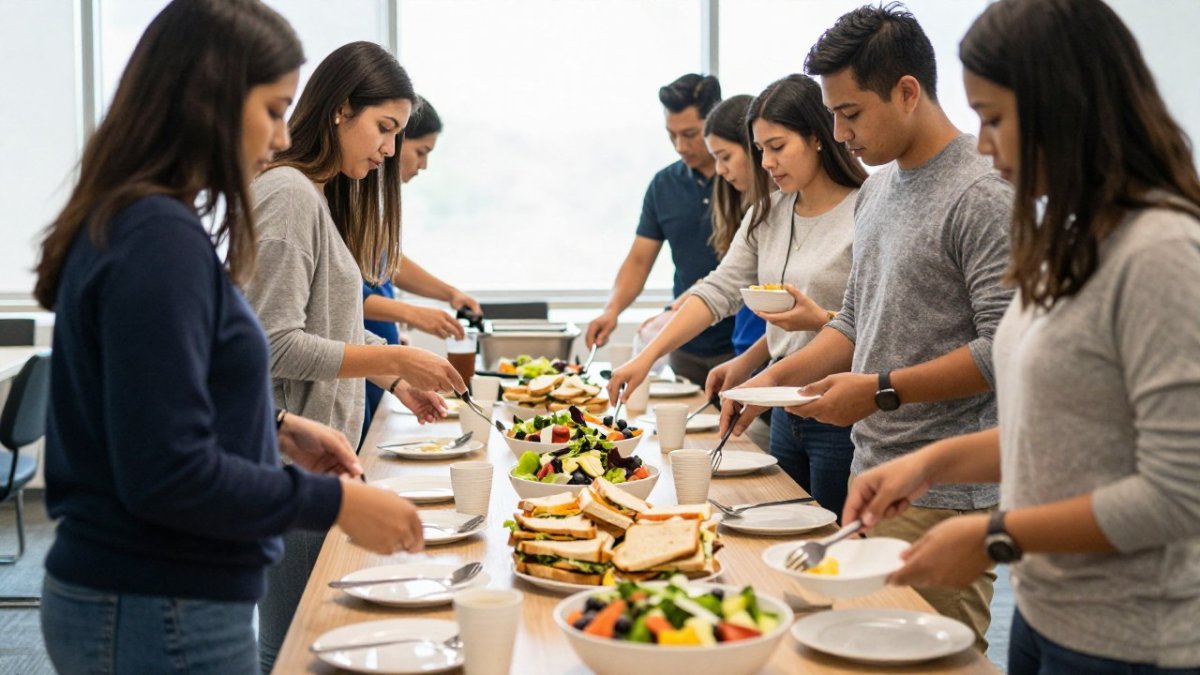
Buffet-style meal service can work well for groups with open floor space. Boxed lunches suit larger groups or any meeting where people eat at staggered times. Browse the lunch menu and formats available to order for your group.
Buffet, Boxed, and Build-Your-Own Stations
Use this quick reference to pick your format before you call anyone:
| Format | Best Headcount | Best For | Main Risk |
|---|---|---|---|
| Buffet-style meal | 20-60 | Team lunch with seating | Long lines, cold food |
| Boxed lunch | 50+ | Staggered schedules | Less variety per person |
| Build-your-own station | 15-40 | Mixed dietary needs | Setup space required |
| Shared spread | 10-30 | Meetings, lunch-and-learn | Portion drift |
Simple Lunch Ideas for Large Groups That Scale Without Chaos
Simple lunch ideas for large groups share one trait: they hold up in a chafing dish or a cooler for an hour without turning to mush. Sandwiches, grain bowls, salads with dressings on the side, and handheld food like wraps and skewers all travel well and serve fast.
The thing nobody tells you about scaling a menu is that variety costs speed. Every additional dish adds a serving utensil, a label, and a decision point at the table. Cap your menu at three mains, two sides, and one dessert.
Cold Lunch Ideas for a Crowd: When You Do Not Have a Heat Source
Cold lunch ideas for a crowd are the answer for conference rooms, outdoor setups, and any office meeting where the nearest outlet is a rumor. Think composed salads, charcuterie and cheese spreads, chilled pasta salads, and tapas-style small plates that taste as good at room temperature as they do fresh.
Tapas deserve a special mention here. Small plates are naturally easy to serve, they let people self-select around dietary restrictions, and they keep portion sizes honest.
How to Order Lunch for a Large Group at Work Without Over-Ordering
To order lunch for a large group at work, collect a firm headcount 48 hours out, add a 10% buffer, and order against a per-person portion target rather than a gut feeling. That single sequence prevents most over-ordering. The harder part is translating a headcount into actual trays, boxes, and bowls, so use the working numbers below instead of guessing.
Portion Math by Format
Portion targets shift with the meal format because serving style changes how much people take. A common pattern among catering planners is:
- Buffet-style meal: plan 1.5 to 2 servings per person across all dishes, with the higher end for active or outdoor events.
- Boxed lunch: order one box per confirmed attendee plus a buffer.
- Build-your-own station: plan 1.5 servings per person of the protein and 2 servings per person of the base (tortillas, rice, pasta), since people over-serve bases.
- Shared spread or tapas: plan 4 to 6 small plates per person, and add one heartier bowl per four people so no one leaves hungry.
Cross-check the full menu and per-item details before you finalize quantities, and confirm whether the caterer counts a “serving” as a full entree portion or a side portion.
Dietary Headcount
DoorDash’s office catering guidance recommends estimating that 15 to 20% of attendees will have a dietary requirement, and building the base order with vegetarian, vegan, gluten-free, or halal options. Use that range as your planning number, then round up: for 40 people, plan 6 to 8 vegetarian servings, 2 to 3 vegan, and 2 to 3 gluten-free, and label each one clearly at the table.
The Ordering Sequence
Run the order in this order so nothing gets renegotiated at the last minute:
- Confirm headcount 48 hours before, and again 24 hours before for a final number
- Add a 10% buffer for walk-ins and last-minute additions
- Plan 15-20% dietary-inclusive items and label them
- Target 1.5-2 servings per person, adjusted for format
- Confirm delivery window, drop-off location, and setup in writing
- Assign one person to receive delivery and one backup
- Arrange pick-up or delivery when you place the order so timing is locked in
Watch out: a headcount collected by email reply will undercount by 10 to 20% because people who plan to attend forget to respond, use a calendar RSVP or a shared sign-up sheet instead, and treat non-responders as attendees for planning purposes.
A practical planning timeline keeps the sequence honest: two weeks out, lock the format and get quotes; one week out, send the RSVP and collect dietary notes; 48 hours out, confirm the headcount and place the order; 24 hours out, reconfirm delivery and assign receivers; the morning of, clear the serving area and set out labels and utensils. That timeline is the piece most guides skip, and it is the one that keeps a 60-person lunch from turning into a scramble.
Budgeting, Delivery Coordination, and Food Safety Logistics
Budget and logistics break more lunches than menus do. Build your budget per person, not per order, and confirm whether delivery, setup, and gratuity are included before you compare quotes. A quote that looks 15% cheaper often excludes delivery and setup, which can add that much back at checkout.
Per-Person Budget Ranges by Format
Use these working ranges to compare formats before you request quotes. They are planning figures, not quotes, actual prices vary by market, menu, and headcount.
| Format | Typical per-person range | What drives the price |
|---|---|---|
| Boxed lunch | $12-$22 | Sandwich or salad choice, side, drink, cookie |
| Buffet-style meal | $18-$35 | Number of mains, protein count, chafing-dish rental |
| Build-your-own station | $20-$40 | Protein selection, staffing for the station, setup |
| Shared spread or tapas | $15-$30 | Number of small plates, cheese and charcuterie weight |
Typical per-person range
When building your approval request, include all costs, such as delivery, setup, and gratuity, not just the food subtotal.
Gratuity and delivery are sometimes quoted separately from the food total, so always ask for the all-in per-person figure in writing before you compare two caterers.
Delivery Coordination
Set a delivery window 30 minutes before the meal starts, name one person to receive it, and confirm the drop-off location in writing, building entrance, floor, room, and whether the driver needs a loading dock or visitor pass. Ask the caterer whether they will set up chafing dishes and serving utensils or drop and go; that difference changes who on your team needs to arrive early.
Food Safety and Leftovers
For food safety, keep hot food above 140°F and cold food below 40°F, and refrigerate leftovers within two hours. Label every dish with its contents and allergens, keep serving utensils dedicated to one dish, and set out hand sanitizer or a hand-washing reminder near the serving line. For leftovers, have containers ready before the meal ends, cool food promptly, and label with the date, most offices discard unlabeled leftovers within 24 hours rather than risk them.
Contingency Planning
A plan for what goes wrong is what separates a smooth lunch from a stressful one. Keep a short contingency list with the order:
- Late delivery: have the caterer’s phone number and a backup number, and set the delivery window early so a delay does not push into the meeting.
- Last-minute headcount changes: the 10% buffer covers most additions; for larger swings, keep a backup option such as a nearby deli or a second small order on standby.
- Missing items: confirm the itemized packing list against the delivery before the driver leaves, and photograph the setup so you have a record.
- Limited kitchen facilities: if the office has no oven or refrigerator, choose formats that hold at room temperature and arrange for the caterer to take away leftovers and equipment.
That contingency list, plus the per-person budget and the delivery confirmation, is the operational core of planning office lunch for large groups, the part that keeps a 60-person lunch on time, on budget, and safe to eat.
Booking a Venue or Caterer for Your Next Team Lunch
Choosing a catering provider comes down to asking whether they can handle your headcount comfortably, whether they offer menu variety across dietary needs, and whether they have a track record with groups your size. When you are ready, submit an event inquiry to book the venue or catering.
The venue matters as much as the food. Ask for the real capacity, not the standing-room number, and check the reservation and group policies before you commit.
The hard part of planning office lunch for large groups is often not the food. It is the coordination, and teams that get it right treat it as a project with an owner, a timeline, and a checklist.
Vino Locale has been hosting lunches and private events in our European-style wine garden since 2005, with outdoor seating, customizable wine flights, and space for up to 100 guests.
Frequently Asked Questions
How much food should I order for a large office lunch?
Plan for a meaningful share of attendees to have dietary requirements, so build your base order around vegetarian, vegan, gluten-free, or halal options. For portion sizing, plan ahead and round up your headcount to cover walk-ins and second helpings. Confirm final numbers with your caterer 48 hours before delivery so they can adjust quantities.
What are easy lunch ideas for a large group at work?
Boxed lunches and build-your-own stations are the easiest formats for large headcounts because they keep lines moving and let people skip ingredients they cannot eat. Taco bars, pasta bars, and sandwich platters all scale well and require minimal serving staff. For a cold option, pre-assembled salads and wrap platters travel well and need no heat source. Match the format to your headcount and schedule.
How do I accommodate dietary restrictions at a team lunch?
Ask for dietary needs in your RSVP or calendar invite at least a week before the event, then tag each meal clearly when it arrives. Plan for some attendees to have restrictions, so order a few vegetarian, vegan, and gluten-free options even if no one flags one. Label every dish with its ingredients and keep serving utensils separate to avoid cross-contact for guests with allergies.
How far in advance should I order catering for an office lunch?
Place your catering order well in advance, especially for larger groups or peak seasons like the holidays. Confirm the delivery window, drop-off location, and contact number 48 hours before the event.
What are good cold lunch ideas for a crowd?
Cold lunch ideas for a crowd include pre-made salad bowls, wrap and sandwich platters, cheese and charcuterie spreads, and grain-based salads like tabbouleh or farro. These options hold up well in transit, need no reheating, and can be set out on a table for self-service. Pair them with individually packaged sides and drinks so guests can grab and go without crowding around a single serving station.
How can I feed a large group on a tight budget?
Choose formats with a lower per-person cost, and let guests serve themselves where possible to reduce waste and staff costs. Pick seasonal produce for salads and sides. Get quotes from at least two caterers and confirm whether delivery, setup, and gratuity are included in the price before you commit.
