

Last Updated: November 1, 2026
Quick Summary
To host an office happy hour, set a clear purpose, guest list, and per-person budget before booking anything, then choose a cost-control mechanism such as drink tickets or a capped hosted bar. A work happy hour should last about 90 minutes to two hours, and the invite should state the what, when, where, and why in plain language.
- Set your per-person budget first, since it shapes the venue, food, and drink options.
- Aim for a 4:30 or 5:00 p.m. start and avoid the last week of a quarter.
- Ask the venue for a written estimate confirming gratuity, room minimums, and the cancellation window.
- Offer real nonalcoholic choices and collect dietary and accessibility needs in the RSVP.
- Track attendance and send a short optional feedback survey after the event.
Table of Contents
- Step 1: Set a Goal, Guest List, and Budget for Your Office Happy Hour
- Step 2: Choose the Date, Time, and How Long a Work Happy Hour Should Last
- Step 3: Book a Venue, Private Room, or Reserved Space
- Step 4: Plan Office Happy Hour Food and Drinks for Every Guest
- Step 5: Send a Work Happy Hour Invitation With Clear Wording
- Step 6: Use Office Happy Hour Ideas That Get People Talking
- Step 7: Host Safely, Inclusively, and Measure How It Went
- Frequently Asked Questions
Step 1: Set a Goal, Guest List, and Budget for Your Office Happy Hour
Learning how to host office happy hour starts with one question: what should this gathering actually accomplish? A team social event with no purpose drifts into awkward small talk.
An office happy hour is a relaxed after-work social event for coworkers, usually held at a bar, restaurant, or private room, with drinks, snacks, and light conversation. The best ones have a clear purpose and a group size the venue can handle comfortably.
Pick a Purpose and a Realistic Group Size
Decide what you want from the event before you pick a date. Common goals include team bonding, welcoming new hires, or celebrating a project wrap. Write the goal down in one sentence, it becomes the test for every later decision (venue, menu, activities, and whether to repeat it).
Then count the guest list. A group of 10 fits a corner table. A group of 40 needs a reserved space. Larger groups usually need advance notice, so check with the venue early.
- Team bonding: keep it small and casual
- New hire welcome: invite the whole department
- Quarterly offsite: book a private room
Build a Per-Person Budget Before You Book Anything
Set your per-person budget first, not last. It shapes everything else: the venue, the food, and the drink options. Most teams find that a fixed per-person cap keeps costs predictable and avoids surprises on the final bill.
Break the number into four cost categories so nothing hides in the final invoice:
- Food, passed appetizers, shared small plates, or a set menu.
- Drinks, the biggest swing factor. A hosted bar with a per-person cap, a limited drink menu (beer, wine, one signature cocktail), or a drink-ticket system each produce very different totals. Nonalcoholic drinks should be budgeted as a real line, not an afterthought.
- Space and service, private-room minimums, rental fees, and mandatory service charges. Ask whether a food-and-beverage minimum applies and whether it counts toward your total.
- Tax, tip, and buffer, add a buffer on top of the subtotal for sales tax, gratuity, and the one extra round nobody planned for.
Ask the venue for a written estimate before you commit. Confirm whether gratuity is automatically added to groups, whether there is a room minimum, and what the cancellation window is. Those three answers prevent most budget surprises.
Get Approval and Pick a Cost-Control Mechanism
Before anyone books a space, confirm who owns the expense and what the approval path looks like. In most organizations the spend falls under a team or department budget, and a manager or finance lead signs off. Put the approved per-person cap in writing so the planner and the approver agree on the ceiling.
Then choose one cost-control mechanism up front:
- Hosted bar with a cap, the venue runs a tab up to a set dollar amount, then switches to a cash bar. Simple, but you must tell guests when the switch happens.
- Drink tickets, each guest gets a fixed number of drink tickets; nonalcoholic drinks are unlimited. Predictable cost and a natural moderation nudge.
- Consumption menu, a limited list of beer, wine, and one cocktail, plus unlimited soft drinks. Easier to forecast than a full bar.
Skipping the budget step is the fastest way to blow past your spend. Agree on the number, the approval path, and the cost-control mechanism before anyone books a space, not after the first invoice arrives.
Step 2: Choose the Date, Time, and How Long a Work Happy Hour Should Last
A work happy hour should last about 90 minutes to two hours. That window gives people time to settle in, eat, and talk without dragging into the evening. End it while energy is still high.
Find a Slot That Does Not Clash With Commutes or Deadlines
Timing matters more than most planners think. A Thursday or Friday late afternoon works well for many teams. Mondays feel rushed, and end-of-quarter weeks are usually packed.
Check the calendar for conflicts first. Avoid launch days, board meetings, and major deadlines. Then send a quick poll so people can vote on two or three options.
- Aim for a 4:30 or 5:00 p.m. start
- Avoid the last week of a quarter
- Confirm the end time in the invite
Step 3: Book a Venue, Private Room, or Reserved Space
Pick the venue type that matches your group and goal. A casual bar suits a small team. A restaurant with a private room fits a larger group that wants to talk without shouting.
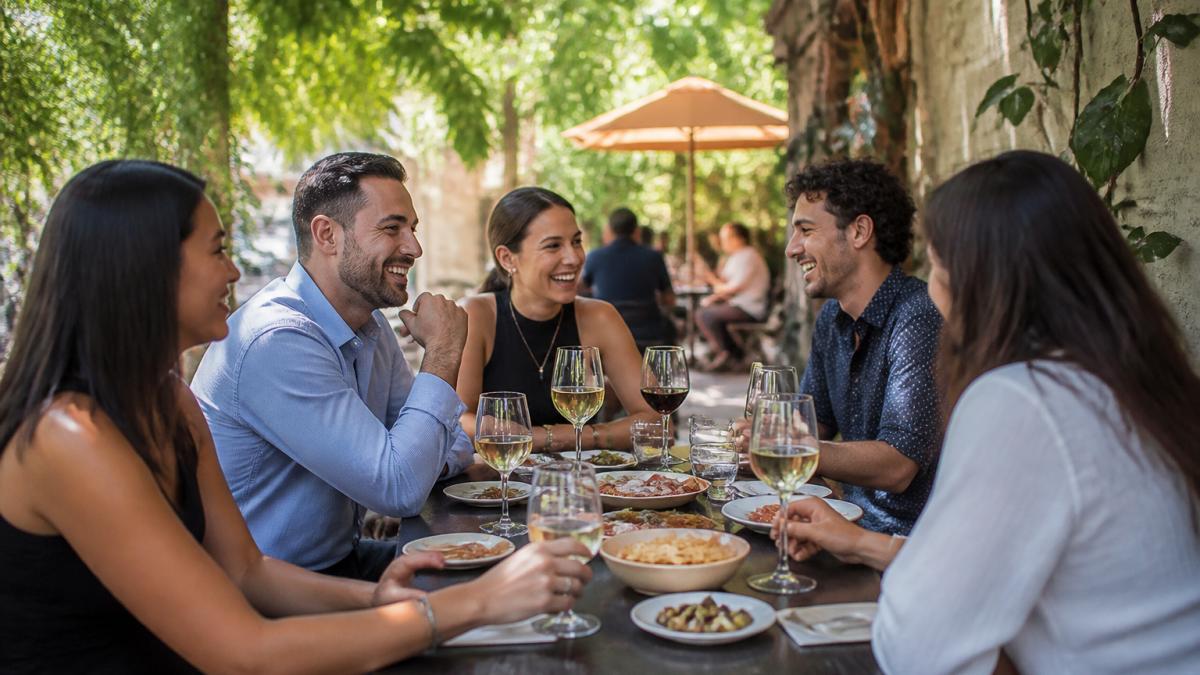
Call ahead and ask three things: how many people the space holds, whether you can reserve it, and what the food and drink options are. A venue that accommodates up to 100 guests gives you room to grow.
Vino Locale offers an outdoor garden and patio seating, and accommodates private events of up to 100 guests. For current availability and details, visit the website.
Step 4: Plan Office Happy Hour Food and Drinks for Every Guest
Food and drinks make or break the event. The key is variety and enough nonalcoholic options so everyone can join in.
Office Happy Hour Food and Drinks That Cover Every Guest
Plan appetizers that are easy to share and easy to eat standing up. Browse the happy hour offerings and pricing. Small plates and snacks work well for a group. Browse the full menu for food and drink options.
- Nonalcoholic options such as sparkling water and sodas
- Wine for the table
- A mix of vegetarian and meat options
Ask about dietary restrictions in the invite. A guest with a food allergy or a non-drinker should never feel like an afterthought.
Step 5: Send a Work Happy Hour Invitation With Clear Wording
Work happy hour invitation wording should state the what, when, where, and why in plain language. Clear invites get more yeses.
Include the date, start and end time, venue name and address, and what is covered. Review the reservation and group policies to communicate logistics accurately.
Example invite: “Join us for a team happy hour on Thursday from 4:30 to 6:00 p.m. at Vino Locale. Food and drinks are on us.
Send a reminder two days before. A scheduling tool or calendar invite helps people commit.
Step 6: Use Office Happy Hour Ideas That Get People Talking
The best office happy hour ideas give people something to do besides stand around. A little structure breaks the ice without feeling forced.
- Conversation starter cards on each table
- A simple trivia round with small prizes
- A wine or beer flight tasting with a host
Skip anything that puts people on the spot. The goal is team bonding, not a performance. A relaxed activity lets quieter coworkers join in at their own pace.
Step 7: Host Safely, Inclusively, and Measure How It Went
A good host thinks about safety, inclusion, and logistics before the first guest arrives. This is the step most planners rush, and it is where a fun event can go wrong, or quietly exclude people who would have loved to join. Establishing these foundational habits creates a reliable framework for social gatherings that mirrors the intentionality required to host productive meetings.
Make the Event Inclusive From the Invite Onward
Inclusion starts with the invitation, not the day of the event. Ask about dietary restrictions and accessibility needs in the RSVP so you can plan rather than improvise.
- Dietary needs, collect restrictions in the RSVP and confirm the venue can handle them. Ask for labeled options so guests with allergies can serve themselves safely.
- Nondrinkers, never assume everyone drinks. Offer real nonalcoholic choices (mocktails, craft sodas, sparkling water) that feel like a first-class option, not a consolation prize. Employees who do not drink for religious, health, recovery, or personal reasons should be able to participate fully.
- Mobility and sensory needs, confirm step-free access, accessible restrooms, and seating for guests who cannot stand for long periods. Ask about noise levels if anyone has sensory sensitivities.
A happy hour that works for the nondrinker, the guest with a food allergy, and the coworker who needs a seat is a better event for everyone, not a compromise.
Host Alcohol Responsibly
Responsible hosting is about clear expectations and practical support, not policing. Set the tone before the event and back it up with logistics.
- Set expectations, state in the invite that the event is a social gathering, that participation is optional, and that professional conduct still applies.
- Keep food coming, serve food throughout so no one drinks on an empty stomach. Passed bites and shared plates keep the pace steady.
- Offer drink limits or tickets, a drink-ticket system or a capped hosted bar gives guests a natural stopping point without singling anyone out.
Handle the Logistics and the Cleanup
Assign one person to own setup and one to own cleanup before the event. Confirm who arrives early to check the space, who settles the final bill, and who makes sure nothing is left behind. If the event is off-site, confirm the venue’s contract terms with the venue before booking.
Measure Participation and Outcomes
After the event, measure how it went with lightweight methods, not a mandatory survey that feels like homework.
- Track attendance, compare RSVPs to actual turnout. A big gap usually signals a timing or communication problem.
- Send a short feedback survey, three or four questions: what worked, what to change, and whether people felt included. Keep it optional and anonymous.
- Watch for connection signals, did people from different teams talk? Did new hires meet people? Those are the outcomes a happy hour is meant to produce.
| Step | What to Do | When |
|---|---|---|
| Set goal and budget | Define purpose, count guests, set per-person cap, confirm approval | 4 weeks out |
| Pick date and time | Poll the team, check for conflicts | 3 weeks out |
| Book venue | Reserve space, confirm capacity and contract terms | 2-3 weeks out |
| Plan food and drinks | Choose menu, collect dietary needs, confirm nonalcoholic options | 2 weeks out |
| Send invite | State details, cost coverage, and optional participation; request RSVP | 1-2 weeks out |
| Plan activities and safety | Set icebreakers, drink limits, and transportation plan | 1 week out |
| Host and measure | Run the event, assign cleanup, send survey | Event day and after |
Frequently Asked Questions
How do you plan an office happy hour on a tight budget?
Set a per-person budget before you choose a venue, then decide what it covers: space, food, drinks, and tip. A reserved area with passed appetizers usually controls cost better than an open bar, because you order a set amount rather than paying per drink. Ask any venue whether there is a minimum spend and whether tax and gratuity are included. Confirm the final headcount a few days ahead so you are not paying for no-shows.
How long should a work happy hour last?
Most work happy hours work best at 90 minutes to two hours. A 5:30 to 7:00 p.m. window catches people before dinner and gives them a reason to leave at a set time, which helps attendance. If the event includes a short team update or awards, add 20 to 30 minutes. Publish the end time in the invitation so people can plan childcare, commutes, and evening commitments.
How can you make an office happy hour inclusive for employees who do not drink?
Offer nonalcoholic drinks that feel like real choices rather than an afterthought. Serve food throughout so nobody is drinking on an empty stomach, and skip drinking games or anything that puts pressure on people to order alcohol. Ask about dietary restrictions and mobility needs in the RSVP, and choose a venue with accessible entry and seating for anyone who wants a calmer space.
What food and drinks should you serve at an office happy hour?
Plan three to four bites per person if the event runs two hours and does not replace dinner. Small plates work well because they are easy to share. For drinks, offer a few options, including nonalcoholic choices. Ask guests to flag allergies and dietary needs in the RSVP, and label dishes at the table so people can serve themselves without guessing.
Planning a team happy hour does not have to be stressful. The trick is a clear goal, a set budget, and a venue that fits your group. Vino Locale has hosted gatherings in our European-style wine garden since 2005, with outdoor patio seating, customizable wine flights, and space for private events up to 100 guests. Get started with Vino Locale and submit an event inquiry to book your team’s happy hour.
