
Last Updated: November 14, 2026
Quick Summary
Picking among palo alto restaurants downtown comes down to five filters: time of day, budget, noise level, reservation policy, and whether you want a patio. Downtown here means the University Avenue corridor, roughly from Middlefield Road to the Caltrain station, and it is compact and walkable.
- Answer the five filter questions before opening a menu to cut dozens of options to three or four.
- Most downtown casual spots fall into three per-person bands: under $20, $20 to $40, and $40 to $60.
- Go before noon or after one to avoid the peak lunch crush between noon and 1 p.m.
- Parties of five to eight should call ahead even at casual spots, since peak hours are when table pushing fails.
- Park once in a garage and walk, because moving the car costs more time than it saves.
Table of Contents
- How to Choose Among Downtown Palo Alto Restaurants
- Where Downtown Begins and Ends
- Five Questions That Narrow the List Fast
- The Best Casual Restaurants in Palo Alto for a Low-Stress Meal
- Downtown Palo Alto Restaurants for Lunch
- Downtown Palo Alto Restaurants for Dinner
- Downtown Palo Alto Restaurants Open Now: Checking Before You Walk
- Outdoor Dining, Patios, and the Parklet Program
- Parking, Transit, and Walking the Downtown Core
- Book a Table or Order Online from Vino Locale
- Frequently Asked Questions
How to Choose Among Downtown Palo Alto Restaurants
Picking among downtown Palo Alto restaurants comes down to five filters: time of day, budget, noise level, reservation policy, and whether you want a patio. Get those sorted and the list shrinks fast. This guide from Vino Locale covers the downtown core block by block, with the practical details most lists skip.
Here’s the good news: downtown is compact and walkable, so you can compare a few options on foot before committing. Below, we’ll show you how to narrow the field, when to book, and where to park.
The article’s five filters for narrowing the list, at a glance.
| Filter | What to decide | Why it matters |
|---|---|---|
| Time of day | Lunch, happy hour, or dinner | Different crowds and kitchen pacing |
| Budget | Set a per-person ceiling first | Narrows options before you open a menu |
| Noise level | Quiet corner or lively room | A working lunch needs quiet |
| Reservation | Book ahead or walk in | Popular dinner slots fill; midday walk-ins usually don’t |
| Seating | Indoors or outdoors | Patio seating changes the experience on a mild evening |
Where Downtown Begins and Ends
For this guide, downtown means the University Avenue corridor and the blocks feeding into it, roughly from Middlefield Road to the Caltrain station. That boundary matters. Plenty of “Palo Alto” lists stretch out to Stanford and the wider Peninsula, which makes them hard to use when you have an hour for lunch.
A restaurant guide is only useful if it tells you which part of town it covers. This one stays inside the walkable center.
Five Questions That Narrow the List Fast
Answer these before you open a menu, and you’ll cut the list from dozens to three or four:
- What time is it? Lunch, happy hour, and dinner draw different crowds and different kitchen pacing.
- What’s the budget? Set a per-person ceiling before you look at a menu, not after.
- How loud can it get? A working lunch needs a quiet corner; a Friday night does not.
When you’re comparing options quickly, the actual menu is the fastest way to judge cuisine, portion style, and fit. Most downtown kitchens post one online, so check before you walk.
The Best Casual Restaurants in Palo Alto for a Low-Stress Meal
Casual dining downtown works best when nobody has to think too hard. The strongest casual restaurants in Palo Alto share three traits: no reservation pressure, a menu that suits mixed appetites, and a room where you can hear the person across the table.
What most guides miss is that “casual” covers two very different meals. There’s the quick sit-down lunch, where speed matters, and the long unhurried table, where it doesn’t. Pick which one you’re having first.
A practical price map for casual meals
Most downtown casual spots fall into three rough per-person bands, before tax and tip. Use these as a planning filter rather than a promise, since menus change:
- Under $20 per person: counter-service cafes, taquerias, and bakery-cafes along University Avenue and the side streets. Order at the counter, bus your own table, and expect to be out in 30 to 45 minutes.
- $20 to $40 per person: full-service casual rooms, the sweet spot for a working lunch or a weeknight dinner with a glass of wine. Table service, but no reservation required most weekdays.
- $40 to $60 per person: the upper edge of casual, where a shared starter and an entrée push the check up. Still no dress code, but book ahead on weekends.
A common pattern is that the same kitchen charges less at lunch than at dinner for a similar plate, so a $40 dinner entrée often has a $25 lunch counterpart. If budget is the deciding factor, eat the same food earlier.
Dietary fit: what to confirm before you commit
Downtown kitchens handle dietary needs unevenly, and “we can modify” means different things at different addresses. Before you commit a group, confirm three things by phone or on the menu:
- Vegetarian and vegan: most casual menus carry at least one vegetarian entrée, but vegan options often require a swap (hold the cheese, substitute the dressing). Ask whether the kitchen stocks a plant-based protein or only removes ingredients.
- Gluten-free: cross-contact is the real question, not the presence of a GF label. Ask whether fries share a fryer with breaded items and whether the kitchen uses a separate prep surface.
- Allergies: for a serious allergy, call during off-peak hours and ask to speak with a manager, not just the host. A casual room at full tilt is the hardest place to guarantee a safe plate.
If someone in your party has a strict need, a smaller casual spot with a short menu is often safer than a large one with a long menu, because there are fewer stations where cross-contact can happen.
Reservation mechanics for casual rooms
Most downtown casual restaurants hold tables for walk-ins and release the rest to reservations. The practical rules:
- Parties of one to four: walk in on weekdays; book on Friday and Saturday after 6 p.m.
- Parties of five to eight: call ahead even at casual spots. Many rooms can only seat a group that size by pushing tables together, and peak hours are when that fails.
- Parties of eight or more: treat it as a reservation, not a walk-in, and expect a set menu or a deposit at some addresses.
A common mistake is treating a casual spot like a special-occasion venue and then feeling rushed by the turnover. If the meal matters, say so when you book. If it doesn’t, walk in and stay flexible.
Watch out: a quoted wait time at a casual spot is an estimate, not a commitment, so build some buffer into any plan with a hard start time.
Downtown Palo Alto Restaurants for Lunch
Lunch downtown is a timing problem more than a taste problem. Office workers, Stanford staff, and residents all converge in the same narrow window, so the difference between a relaxed meal and a stressed one is usually when you arrive.
The actual lunch windows
Downtown lunch runs in three overlapping waves, and each one behaves differently:
- 11:30 a.m. to noon: the calm window. Tables are open, kitchens are fresh, and you can usually walk in without a wait. Best for a meeting where you need to talk.
- Noon to 1 p.m.: the peak. This is when the line forms, the kitchen tickets stack up, and a 45-minute meal stretches to 75. Avoid if you have a hard return time.
- 1 to 2 p.m.: the second calm window. The office crowd thins, tables free up, and service speeds back up. Best for a late lunch that still feels like lunch.
Two practical rules follow. First, go before noon or after one. Second, pick a spot that handles a midday crowd without turning your table.
Budget bands at lunch
Lunch is where downtown’s price range is widest, and the same address can look expensive at dinner and reasonable at midday:
Group lunch: the mechanics that matter
Groups are where lunch plans fail, and the failure is predictable:
- Five to eight people: call ahead the morning of. Many downtown rooms can seat a group that size, but only if they know before the rush.
- Eight or more: book 24 to 48 hours ahead and expect a set menu or a per-person minimum at some addresses. Walk-in groups at peak midday often get split across tables or turned away.
- Separate checks: ask before you order. Some casual spots handle split checks at the table; others require one check per table, which turns a simple lunch into a 10-minute payment negotiation.
For anyone planning a midday meal and wanting to see the details before deciding, the lunch offerings are worth checking ahead of time. That saves the awkward standing-in-the-doorway scroll.
Dietary needs at lunch
Lunch is the hardest meal for dietary accommodations because the kitchen is at full speed and substitutions slow the line. If someone in your group is vegetarian, vegan, or gluten-free, check the menu online before you arrive and call during the 10 to 11 a.m. lull, when the kitchen has time to answer.
Watch out: a restaurant that is quiet at 11:45 can be full at 12:10. If you have a hard return time, arrive before noon or after one, not in between.
Downtown Palo Alto Restaurants for Dinner
Dinner is where downtown shows its range. You can eat well at a casual neighborhood table or settle in for a long, deliberate meal, and both sit within a few blocks of each other.
For a date night, the room matters as much as the food. If you’re weighing whether the area delivers on romance, this take on whether Palo Alto is actually a good date night city digs into the question properly.
Happy hour changes the dinner math. Many downtown spots run early-evening specials, so a drink and a few small plates can replace a full entrée. Check current happy hour timing and offers before you plan around it.
Downtown Palo Alto Restaurants Open Now: Checking Before You Walk
“Open now” is the most common search and the most often wrong. Hours shift with the season, private events, and staffing, and a listing that says open may not be.
Check the restaurant’s own site or call before you walk. Two minutes on the phone beats a twenty-minute round trip to a dark dining room.
Here’s the insider move: if a place looks closed but the patio is set, it may be between services.
Outdoor Dining, Patios, and the Parklet Program
Outdoor dining downtown isn’t just a seasonal bonus. According to the City of Palo Alto Outdoor Dining Program, businesses can expand outdoor dining and retail space into public parking areas through custom or pre-approved parklets.
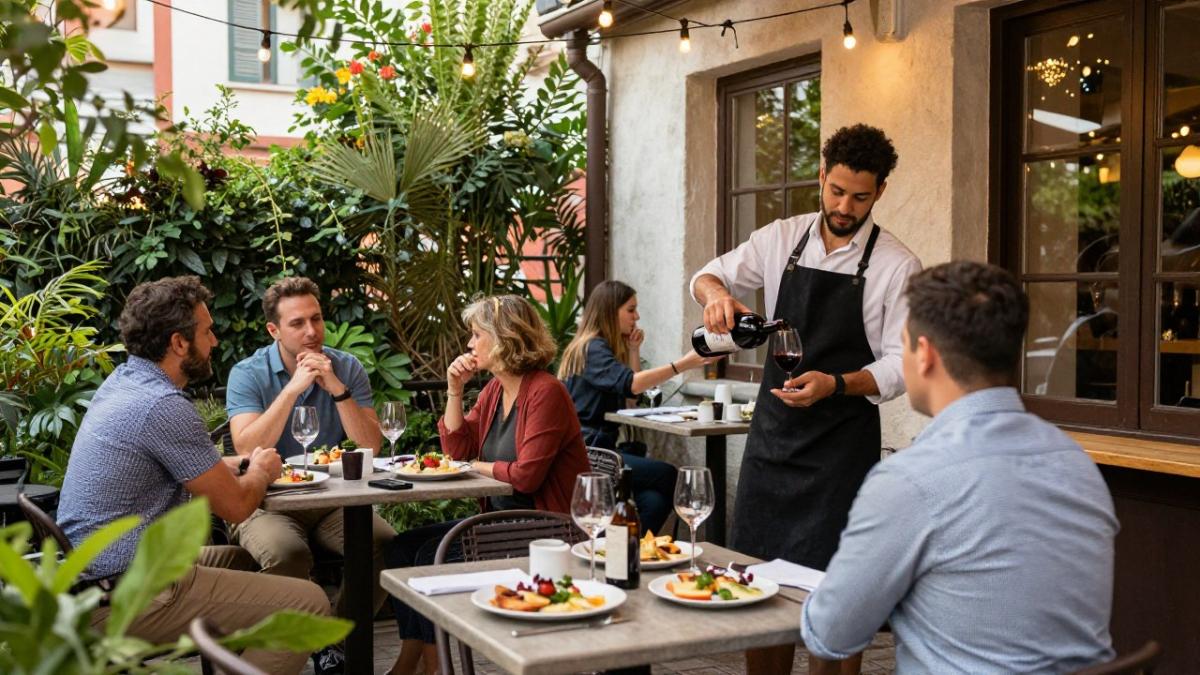
That means more patio seating than the sidewalks alone would allow, and it’s why so many downtown restaurants can offer outdoor tables on a busy evening.
When you’re choosing, ask whether the patio is heated and covered. A mild evening is lovely; a windy one is not.
Parking, Transit, and Walking the Downtown Core
Parking is the part of the plan people leave to the last minute, and it’s the part most likely to ruin a good reservation.
Walking is a practical way around the core, and the blocks from Middlefield to the Caltrain station are compact.
A practical approach: park once in a garage, then walk. Moving the car between two nearby restaurants costs more time than it saves.
Book a Table or Order Online from Vino Locale
If you want one downtown address that handles lunch, happy hour, dinner, and a group of forty without drama, Vino Locale is our pick.
For office teams, that means a relaxed setting for team building and mid-day discussions. Ordering is easy too: use the pick-up or delivery page to place an order for your office.
The real challenge downtown isn’t finding a restaurant. It’s matching the room to the moment, then confirming the details before you commit.
Frequently Asked Questions
What are the best restaurants in downtown Palo Alto?
The best choice depends on the occasion rather than a single ranking. For a quick workday lunch, look for counter-service spots and cafes along University Avenue. For dinner, the downtown core mixes high-end rooms with affordable options that draw Stanford students and office workers. Vino Locale, a European-style wine garden and kitchen open since 2005, offers wine flights, tapas, and outdoor garden and patio seating.
Where can you get lunch in downtown Palo Alto?
Lunch options cluster around University Avenue and the surrounding blocks, ranging from bakeries and cafes to full-service kitchens. Office workers often look for places with outdoor seating for a midday break. If you need to eat at your desk, check whether the restaurant offers online ordering for pickup or delivery, and confirm the drop-off window before you count on it.
Which downtown Palo Alto restaurants have outdoor seating?
Several downtown spots offer patios, and outdoor footprints can change, so confirm patio availability when you book.
How do I find downtown Palo Alto restaurants open now?
Check the restaurant’s own website or reservation page for current hours, and call ahead to confirm before you visit. If you are ordering for an office, place the order during service hours and confirm how the food is packed for pickup or delivery.
