
Last Updated: November 4, 2026
Quick Summary
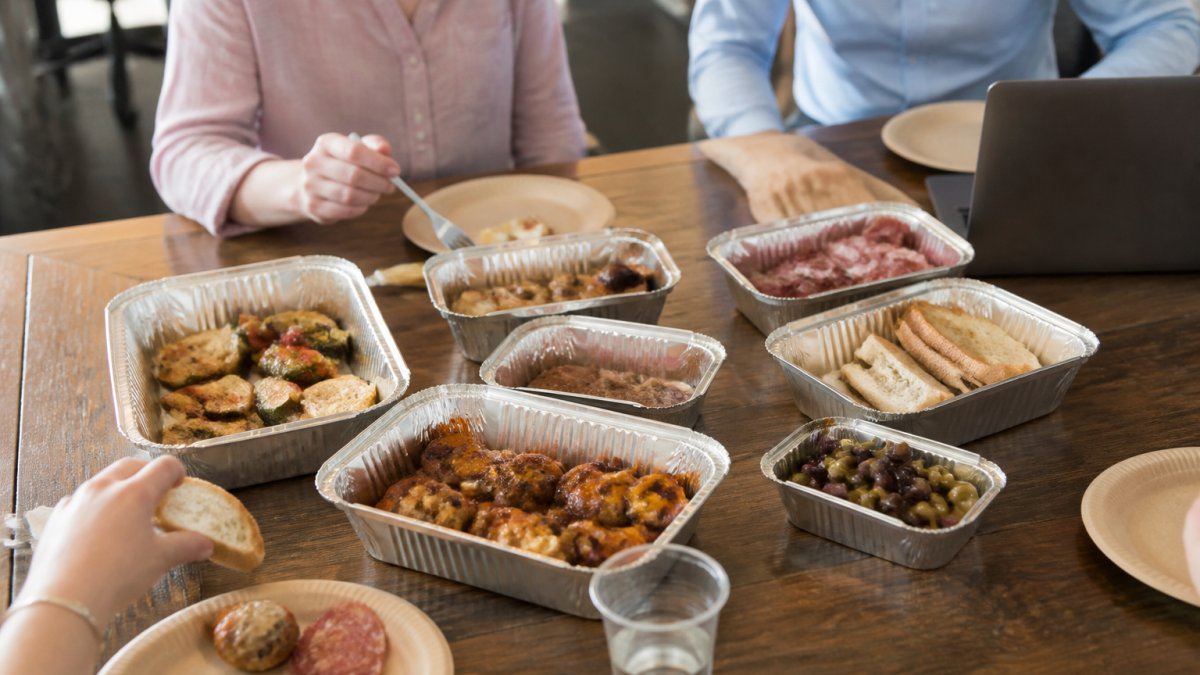
Tapas delivery works well for office lunch meetings because shared small plates get people talking and keep lunch from turning into a two-hour affair. Plan three to four pieces per person for a 60-minute meeting and five to six for two hours or longer. Use shared tapas for team lunches and training days, and boxed lunches only when speed matters.
- U.S. corporate catering spending reached roughly $25 billion in 2025, with companies ordering three to four times a month.
- Add one large salad per 15 people and a couple of starch dishes to round out the spread.
- Allow 20 to 30 minutes of setup time for a 40-person order, not five.
- Perishable food should not sit between 40°F and 140°F for more than two hours.
- For 25 people, expect one to three vegetarian requests and one gluten-free request as a normal pattern.
Table of Contents
- Why Tapas Delivery Fits Office Lunch Meetings
- Office Lunch Catering: What to Order and How Much
- Corporate Lunch Catering Ideas That Travel Well
- Work Lunch Catering Logistics: Delivery, Setup, and Food Safety
- Dietary Labels and Allergen Management for Group Orders
- What Tapas Delivery Costs and How to Budget
- Ordering Tapas Delivery from Vino Locale for Your Next Meeting
- Frequently Asked Questions
Why Tapas Delivery Fits Office Lunch Meetings
Tapas delivery for office lunch meetings works because shared small plates turn a working lunch into something people actually look forward to. U.S. corporate catering spending reached roughly $25 billion in 2025, according to CaterCamp’s 2026 corporate catering statistics, and the average company orders catering three to four times a month. At Vino Locale, we have served downtown Palo Alto since 2005, and we know that teams want food that feels generous without turning lunch into a two-hour affair. A spread of small plates does exactly that. People take what they want, conversations start over the food, and nobody is stuck with a sad sandwich. Below, we break down what to order, how much, and how to keep it fresh.
Shared Plates vs. Boxed Lunches for Meetings
Boxed lunches win on control. Everyone gets an identical portion, dietary needs are easy to label, and cleanup takes minutes. Shared platters win on everything else. Research from Fooda’s 2026 Workplace Lunch Report found that 83% of workplace leaders say food impacts workplace culture, and one in three companies still has no food program at all. That gap matters. A table of shared dishes invites people to linger and talk, which is the whole point of a team lunch. Boxed lunches end the moment the last wrapper hits the bin.
Our take: use boxed lunches for large all-hands sessions where speed matters, and shared tapas for team lunches, training days, and any meeting where you want people to stay and chat.
Office Lunch Catering: What to Order and How Much
Office lunch catering works best when you plan portions by headcount and meeting length rather than guessing. A standard rule for shared small plates is three to four pieces per person for a 60-minute meeting, and five to six for anything running two hours or longer. , according to CaterCamp’s catering benchmarks, which gives you a realistic budget frame before you start choosing dishes.
Portion Planning by Headcount and Meeting Length
Use this as your starting grid, then adjust for appetite and time of day:
| Headcount | 60-minute meeting | 2-hour meeting | All-day session |
|---|---|---|---|
| 10 people | 30-40 pieces | 50-60 pieces | 70-80 pieces |
| 25 people | 75-100 pieces | 125-150 pieces | 175-200 pieces |
| 40 people | 120-160 pieces | 200-240 pieces | 280-320 pieces |
Add one large salad per 15 people and a couple of starch dishes to round it out. If your group skews toward grazers who eat light, plan on the lower end. Hungry teams after a morning of presentations will clear the upper end every time.
Corporate Lunch Catering Ideas That Travel Well
Corporate lunch catering ideas that travel well share one trait: they hold their texture for 30 to 60 minutes after packing. That rules out anything fried, anything drowned in sauce, and anything that wilts the second it hits a lid. It favors dishes built to sit at room temperature.
Here is what we would put on a delivery-friendly tapas spread:
- Marinated olives and almonds – better after 20 minutes, not worse
- Spanish tortilla – dense, sliceable, holds heat well in a chafing dish
- Charcuterie and cheese boards – assembled cold, no last-minute work
- Large salads with dressing on the side – keeps greens crisp
- Empanadas and stuffed pastries – sturdy crusts that survive a car ride
- Patatas bravas with sauce separate – the potato stays crisp, the sauce goes on at the office
You can browse the full menu to see which dishes fit your group best. The pattern to remember: separate the wet from the dry, and the food arrives looking the way it left the kitchen.
Work Lunch Catering Logistics: Delivery, Setup, and Food Safety
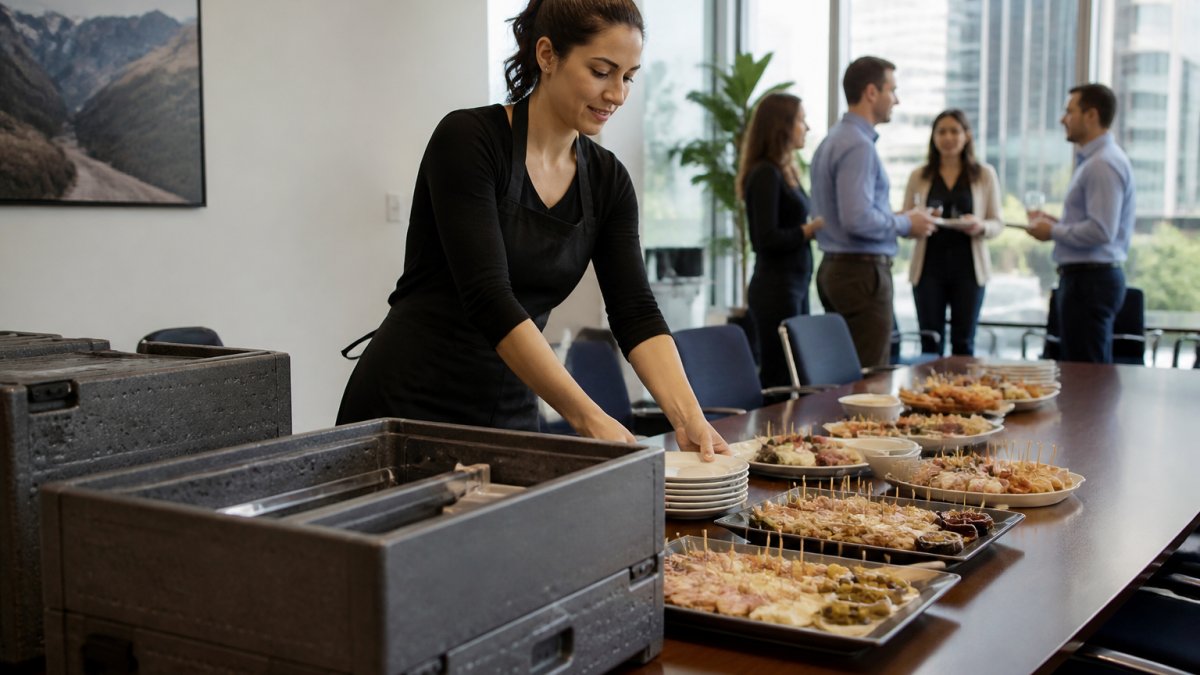
Work lunch catering logistics come down to four things: when the food arrives, how the driver gets into the building, who sets it up, and how long it can safely sit out. Most offices plan the first and forget the other three, which is how a catered lunch ends up cooling in a lobby while someone hunts for a loading dock code.
Plan for arrival a little before your meeting starts. That buffer covers traffic and gives you time to lay out serving trays before anyone walks in hungry.
Building access is the most common failure point. Confirm these details with your building manager at least two business days before delivery:
- Loading dock or service entrance location and hours
- Freight elevator reservation if your meeting room is above the ground floor
- Security check-in procedure for the driver, including whether a photo ID and vendor name are required
- Certificate of insurance requirement, which many commercial buildings ask caterers to provide
- Delivery window the building will actually accept, which may be narrower than your meeting window
Give the caterer the building address, the loading dock entrance, a contact name and mobile number, and the room number in the order notes. A driver who has to call three people to find the room adds 10 minutes to a 20-minute buffer.
Setup equipment matters more for tapas than for boxed lunches. Ask what the caterer provides and what you need to supply. For a 25-person meeting, plan on 50 to 75 small plates if people will return for seconds, plus a stack of napkins and a lined trash can near the table.
Food safety is the part people skip. The USDA’s food safety guidance is clear that perishable food should not sit in the temperature danger zone, between 40°F and 140°F, for more than two hours.
Have a contingency plan for the three things that go wrong most often. First, a late delivery: keep a backup option on file, such as a nearby deli that can deliver a platter within 30 minutes, and confirm the caterer’s on-time guarantee before you book. Second, a headcount change: ask whether the caterer can add 10% to the order on 24 hours’ notice, and keep a buffer in your budget. Third, a missing item: check the order against the packing list before the driver leaves, and get the driver’s mobile number so you can call about a missing platter rather than emailing.
Check our group policies for lead times, delivery windows, and setup details before you book.
Dietary Labels and Allergen Management for Group Orders
Dietary labels and allergen management are where group orders go wrong most often. A single unlabeled dish can sideline a colleague with a serious allergy, and guessing is not an option.
Start with a two-part system: a platter card and a per-dish ingredient list. The platter card sits next to the food and tells people what they can safely take at a glance.
A meeting-ready platter card uses four fields:
- Dish name in large type, readable from arm’s length
- Dietary tags as text, not just symbols: Vegetarian, Vegan, Gluten-Free, Contains Dairy, Contains Nuts, Contains Shellfish
- Heat level if the dish is spicy, so people are not surprised
- Serving utensil note when a dish needs its own tongs or spoon
Color dots alone fail because roughly 1 in 12 American adults has some form of color vision deficiency, and a red dot and a green dot can look identical under conference-room lighting.
Build an allergen matrix before you order.
Separate serving utensils are not optional. A single tongs used for a shrimp dish and then a salad can transfer shellfish protein to a dish that was otherwise safe.
Collect dietary needs in the calendar invite, not the day of. A simple RSVP question, “Any dietary restrictions or allergies we should know about?”, gives your caterer a week to adjust.
Watch out: a dish labeled “gluten-free” can still be cross-contaminated in a shared kitchen, so ask whether the caterer prepares gluten-free items on separate equipment and confirm the answer in writing.
On meeting day, set allergen-containing platters at one end of the table and allergen-free platters at the other, with a small sign marking each zone.
What Tapas Delivery Costs and How to Budget
Pricing depends on quantity, dates, and delivery, so there is no single number to quote. What we can tell you is how to build a budget that holds up. Start with a per-person target, then work backward into dishes.
A workable budget formula:
- Set your per-person ceiling based on your own budget
- Allocate your budget across small plates, salads and starches, and drinks and extras
- Add delivery and any setup fees on top, not inside, the food budget
- Keep a 10% buffer for a last-minute headcount bump
The corporate catering and office lunch delivery market was estimated at $2.01 billion in 2025 and projected to reach $2.24 billion in 2026, per 360iResearch’s market analysis, which tells you delivery is now a standard expectation rather than a premium add-on. Ask your caterer for a written quote against your final headcount, and confirm the order minimum and delivery fee before you commit.
Ordering Tapas Delivery from Vino Locale for Your Next Meeting
Ordering tapas delivery from Vino Locale for your next meeting takes about five minutes online. Our European-style wine garden and kitchen offers a relaxed setting for gatherings. We accommodate private events of up to 100 guests, so a 40-person quarterly offsite is well within our range.
Here is how we would plan it:
- Confirm your headcount and meeting length
- Pick three to four small plates per person from the menu
- Add a large salad and one starch
- Note dietary needs and allergens in your order
- Schedule delivery ahead of start time
You can place your pick-up or delivery order directly, or look at lunch options if you are still deciding. If you want ideas beyond the meeting itself, our guide to hosting corporate team building events pairs well with a tapas lunch.
Frequently Asked Questions
How many tapas should you order per person for a lunch meeting?
Serving sizes vary by dish, so confirm portions with us before you finalize headcount. Order slightly above your count: extra food is cheaper than a room of hungry attendees, and leftover shared dishes can be packed up afterward.
Are tapas a good choice for a business lunch meeting?
They work well when the meeting is informal and people eat while talking. Shared small plates encourage conversation and let guests with different food preferences build a plate they actually want. For a formal presentation with a fixed agenda, boxed lunches or individual portions are easier to manage because nobody is passing platters mid-sentence. Match the format to the tone of the meeting rather than defaulting to one style.
How far in advance should you order office lunch catering?
Ask us about lead times when you book, especially for larger teams or orders with dietary requirements. If you are ordering for a recurring team lunch, confirm the count with us ahead of time.
How do you accommodate dietary restrictions when ordering tapas for a team?
Collect restrictions when you send the meeting invite, not on the day of the lunch. Ask the restaurant which dishes are vegetarian and which contain common allergens. Label each platter at setup so people can serve themselves without guessing. For severe allergies, confirm ingredient details directly with the restaurant rather than relying on menu descriptions alone.
The hardest part of a working lunch is not the food. It is getting people to stay, talk, and come back next time. Shared tapas solves that, and Vino Locale makes it simple with online ordering for pickup or delivery, a menu built for groups, and a garden setting that turns a routine meeting into something people remember. Get started with Vino Locale and give your next office lunch a reason to run long.
