


Last Updated: November 24, 2026
Quick Summary
To find catering for lunch meetings, start with the meeting itself: confirm headcount, occasion, seating, and budget per person before browsing menus. Then shortlist three to five local caterers, verify their service area and delivery windows in writing, and compare written quotes on food cost, fees, and minimums.
- Ask the building first about approved vendors and delivery access rules before shortlisting caterers.
- Request menus with per-person pricing from three to five candidates and confirm delivery windows in the same email.
- Aim for food to arrive 15 minutes before the meeting starts, not during opening remarks.
- Collect dietary needs with RSVPs and set a cutoff at least three business days before the meeting.
- Ask each caterer for both the order deadline and the headcount change deadline, then calendar them.
Table of Contents
- Start With the Meeting, Not the Menu
- A Step-by-Step Method for Finding Local Caterers
- Comparing Restaurants With Catering Menu and Prices
- Lunch Catering Ideas for Work That Travel Well
- Small Catering for 50 Guests on a Budget
- Individual Lunch Box Catering Near Me: When Boxes Beat Platters
- Delivery Logistics for Palo Alto Offices
- Dietary Needs, Allergens, and the Questions to Ask
- Ordering Deadlines and a Backup Plan That Saves the Meeting
- Book a Private Room for Your Next Lunch Meeting
- Frequently Asked Questions
Start With the Meeting, Not the Menu
Most teams approach how to find catering for lunch meetings by opening a browser, typing “catering near me,” and scrolling until something looks good. That’s backwards. The meeting itself decides what food works: the headcount, the room, the schedule, and whether people will eat at a table or balance a plate on their knee.
A menu that lands beautifully in a garden for a 12-person team lunch falls apart when 40 people need to eat in 20 minutes between sessions.
So before you look at a single sandwich tray, answer four questions: lunch menu options
- How many people are eating? Ten and 50 are different projects, not different quantities of the same project.
- What’s the occasion? A lunch-and-learn rewards easy-to-eat food. A client meeting rewards a seated format.
- Where will people sit? A conference room with no windows and one table changes everything about how food should be served.
- What’s the budget per person? Set it before you shop, not after. It filters caterers faster than any review score.
Write those four answers down. They become your filter for every conversation that follows.
A Step-by-Step Method for Finding Local Caterers
The fastest route to a good caterer is a shortlist of three, not a list of thirty. Here’s the method we’d use if we were ordering for an office down the street in downtown Palo Alto.
- Ask the building first. Many Palo Alto offices have building-approved vendors or delivery access rules. Finding that out on day one saves a rejected delivery.
- Collect recommendations from nearby teams. Nearby offices order the same food for the same meetings. Their shortlist is better than any search result page.
- Check the service area before anything else (more on that below).
- Request menus with per-person pricing from three to five candidates.
- Ask about delivery windows and order deadlines in the same email. A caterer who can’t confirm a delivery window can’t cater a meeting.
- Book a small trial order before committing to a large group meal.
- Confirm in writing the headcount, delivery time, contact person, and payment terms.
For a broader planning framework, our 7 steps to plan corporate events in Palo Alto walks through the full event timeline, not just the food.
Verify the Service Area Before You Fall in Love With a Menu
A caterer’s website can look perfect and still not deliver to your zip code. Service areas change with traffic, staffing, and delivery volume, so verify before you build a meeting around a menu.
Ask three direct questions: Do you deliver to this address? Is there a minimum order for that area? What delivery window can you guarantee?
A common mistake is assuming a nearby restaurant delivers. Proximity and delivery coverage are not the same thing, especially around downtown Palo Alto during a weekday lunch rush. Get the answer in writing, and name the exact street address in your inquiry.
A Practical Screening Checklist for Palo Alto Caterers
Once you have three to five candidates, screen them against the same criteria so you can compare fairly. Most meeting organizers find that a simple scorecard keeps the decision objective.
- Service area confirmed for your street address. Ask for the answer in writing, not a general “we deliver to Palo Alto” statement.
- Minimum order and delivery fee disclosed up front. A low per-person price with a high minimum can cost more than a higher per-person price with no minimum.
- Delivery window guaranteed. For a noon meeting, a 11:45 a.m. to 12:15 p.m. window is workable; “sometime between 11 and 1” is not.
- Order and change deadlines stated. Know the last day to place the order and the last day to change the headcount.
- Menu format matches the room. Boxed meals for staggered arrivals, platters for seated groups.
- Allergen and dietary process explained. Ask how they label items and handle cross-contact.
- One named contact for the day of delivery. A phone number that reaches a person, not a general voicemail.
Watch out: a caterer who is vague about delivery windows or minimum orders before you book is likely to be vague on the meeting day too. Treat unclear answers as a screening failure, not a detail to sort out later.
How to Compare Quotes Side by Side
Ask every candidate for a written quote that separates food cost from delivery and setup. Then compare on five lines: per-person food cost, delivery fee, minimum order, taxes and fees, and what is included in setup (serving utensils, chafing dishes, labels). A quote that looks cheaper on the food line can lose on the fee lines.
For a single office lunch in Palo Alto, a local restaurant is usually the better call. You talk to the kitchen directly, and you can adjust the order when the headcount shifts.
Comparing Restaurants With Catering Menu and Prices
Comparing restaurants with catering menu and prices means comparing five things: per-person cost, minimum order, delivery fee, format, and how much notice the kitchen needs. Price alone tells you almost nothing about which option fits your meeting.
Ask every candidate for a written quote that separates food cost from delivery and setup. Some quotes look cheaper until the delivery fee and minimum order land on top. Others look expensive until you realize the tray feeds more people than you assumed.
Local Restaurants vs. Corporate Catering Platforms
Local restaurants usually win on food quality and price per head. Corporate platforms win on logistics: one invoice, centralized ordering, and predictable delivery windows across many cities.
| Factor | Local Restaurants | Corporate Catering Platforms |
|---|---|---|
| Food quality and freshness | Usually stronger | Varies by partner kitchen |
| Per-person price | Often lower | Higher, with platform fees |
| Minimum orders | Common | Rare |
| Delivery reliability | Depends on the kitchen | More standardized |
| Menu flexibility | High, with direct contact | Limited to listed options |
| Best for | Teams that value food | Multi-city or recurring orders |
For a single office lunch in Palo Alto, a local restaurant is usually the better call. You talk to the kitchen directly, and you can adjust the order when the headcount shifts.
Lunch Catering Ideas for Work That Travel Well
Food that travels well is the whole game for office lunch catering. The best options hold their texture for 30 minutes in a car and still look appetizing when the lids come off.
Here’s what to look for on a shortlist:
- Sandwich trays and wrap platters. Sturdy, stackable, and easy to portion.
- Homestyle meals in individual portions. Think grain bowls, roasted vegetables, and braised dishes that improve rather than degrade in a warm container.
- Shared platters for seated groups. Better for a team that eats together at one table.
- Boxed meals for large or staggered groups. Each person takes one, and nobody waits in line.
Avoid anything that needs to be assembled on site, anything that wilts fast, and anything that requires a knife and fork if the room has no tables. A buffet-style spread sounds generous until 30 people are juggling plates in a hallway.
Small Catering for 50 Guests on a Budget
Feeding 50 people on a budget comes down to format, not food quality. Individual portions and boxed meals stretch further than platters because there’s less waste and no guesswork about how much each person takes.
A few moves that protect the budget:
- Choose a two-item menu instead of five. Fewer dishes, larger quantities, less waste.
- Skip the dessert add-on and put the money into a better main.
- Pick up instead of delivery if someone on the team can collect the order.
- Order slightly under the headcount. A small buffer covers no-shows without paying for food nobody eats.
For deeper guidance on scaling an order for a bigger group, our complete guide to planning office lunch for large groups covers quantities, timing, and menu planning in detail.
Individual Lunch Box Catering Near Me: When Boxes Beat Platters
Individual lunch box catering near me is the search that solves a very specific problem: a group where people arrive at different times, have different dietary needs, or can’t share a table.
Boxes beat platters in five situations:
- Staggered arrivals. Latecomers still get a complete meal.
- Mixed dietary needs. Vegetarian, gluten-free, and standard boxes get labeled and separated.
- Grab-and-go meetings. People eat at their desks or between sessions.
- Large groups. No serving line, no bottleneck.
- Allergen control. Each box is sealed, so cross-contact risk drops.
Shared platters still win for a seated team lunch where the meal is part of the conversation. Match the format to the room, not to the photo on the website.
Delivery Logistics for Palo Alto Offices
Delivery logistics decide whether a catered lunch feels effortless or chaotic. The food is only half the job; the other half is getting it into the right room at the right time.
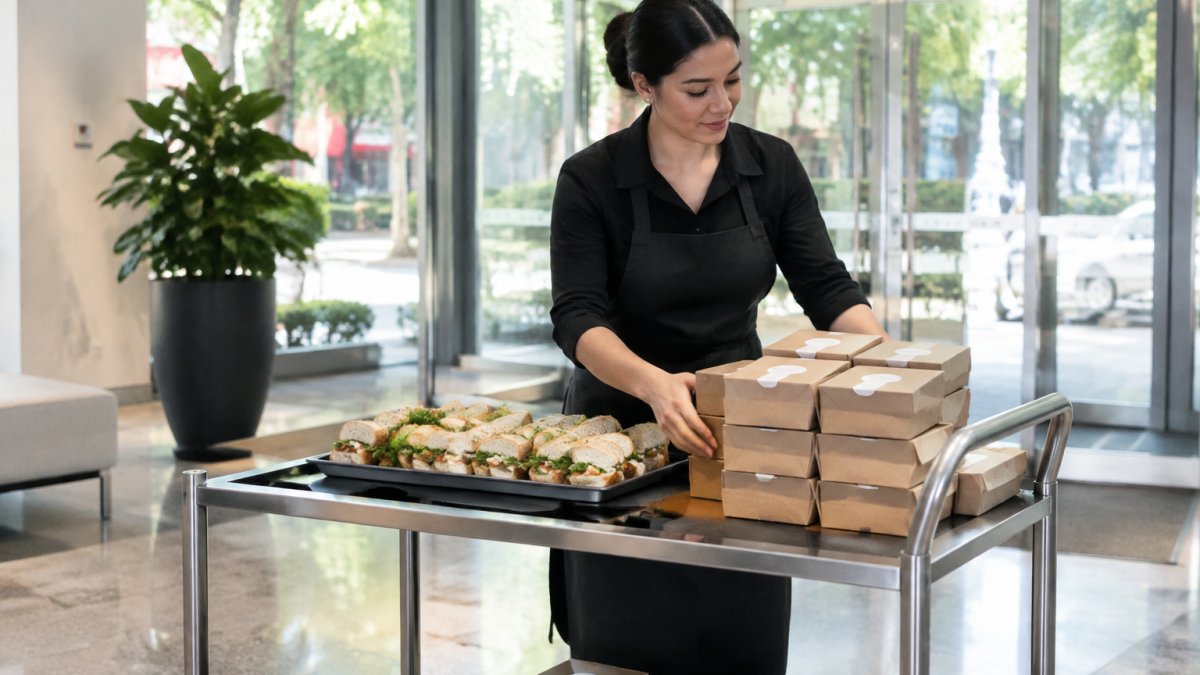
Confirm these details before the meeting day:
- Loading access. Which entrance can a delivery driver use, and is there a freight elevator?
- Parking. Downtown Palo Alto parking is tight at lunch. Ask the driver to call ahead.
- Delivery window. Aim for food to arrive 15 minutes before the meeting starts, not during the opening remarks.
- Setup contact. Name one person who will meet the driver and sign for the order.
- Chafing dishes and serving tools. Confirm what the caterer provides and what your office supplies.
Once you’ve chosen a caterer, our online ordering for pickup or delivery makes it easy to place the order and lock in a delivery window.
Dietary Needs, Allergens, and the Questions to Ask
Dietary needs and allergens are the part of meeting catering that quietly ruins lunches. A guest with a serious allergy can’t just pick around a shared platter, and a team member who eats plant-based shouldn’t be left with a side salad. Proactive communication regarding these requirements ensures that every participant feels valued, a standard that remains essential when you choose office catering to support a productive and inclusive workplace culture.
Collect Dietary Requirements Before You Request Menus
The most reliable process is to collect dietary needs at the same time you collect RSVPs, not after the menu is set. A short form with checkboxes for vegetarian, vegan, gluten-free, dairy-free, and “other allergy” gives the caterer a clear count instead of a vague request.
- Ask for the count, not the names. The caterer needs to know how many of each type, not who they are.
- Separate preference from allergy. A vegetarian preference and a severe nut allergy require different handling.
- Set a cutoff date. Collect responses at least three business days before the meeting so the caterer can plan.
- Confirm the final count in writing with the caterer and note any late additions.
Questions to Ask Every Caterer
Ask every caterer these questions before you book:
- Can you label each item with its major allergens?
- Do you prepare vegetarian and gluten-free options in a separate area?
- Can you provide individual portions for guests with severe allergies?
- Who on your team can answer a question about ingredients on the day of delivery?
- Can you handle a last-minute dietary request?
The U.S. Food and Drug Administration publishes guidance on the major food allergens, and it’s worth knowing the list before you build a menu (the FDA). A caterer who can’t answer these questions clearly is a risk, not a bargain.
Verify Allergen Handling, Not Just Allergen Labels
A label tells you what is in a dish; it does not tell you how the kitchen prevents cross-contact. Ask directly: Is there a separate prep area for allergen-free items? Are utensils and cutting boards dedicated? Can the kitchen confirm ingredient sourcing for a severe allergy?
Watch out: a caterer who says “we can make it gluten-free” without describing the prep process may still use shared equipment. For a guest with celiac disease or a severe nut allergy, that distinction matters more than the menu description.
Match the Format to the Dietary Mix
Individual boxed meals make dietary handling easier because each box can be labeled and sealed. Shared platters work for a seated group where dietary needs are simple, but they require clear labeling and separate serving utensils for each item. If your group has more than one or two severe allergies, boxed meals or individually portioned dishes reduce the risk of a mix-up.
A clear dietary count collected in advance is the difference between a smooth service and a last-minute scramble. Confirm the process with your caterer in writing, and name one person on your team who will answer dietary questions on the day of delivery.
Ordering Deadlines and a Backup Plan That Saves the Meeting
Ordering deadlines are the single most common reason a catered lunch goes wrong. Most kitchens need advance notice for large groups, and the window grows during busy weeks and around holidays.
Ask each caterer for two dates: the deadline to place the order and the deadline to change the headcount. Put both on your calendar with a reminder two days before.
Then build a backup plan. A few simple moves cover most failures:
- Keep a shelf-stable backup in the office pantry: crackers, fruit, and bottled drinks.
- Have a second caterer on file who can take a smaller, same-day order.
- Confirm the order 24 hours ahead by phone, not email.
- Name a backup contact in case the primary person is out sick.
A backup plan costs almost nothing and saves the meeting when a delivery runs late.
Book a Private Room for Your Next Lunch Meeting
Sometimes the best catering decision is to leave the office entirely. A private room solves the delivery problem, the setup problem, and the “nowhere to sit” problem in one move.
Vino Locale is a European-style wine garden and kitchen in downtown Palo Alto, set in a 1906 Victorian House. We host private events for up to 100 guests. Our garden and patio seating gives a lunch meeting room to breathe.
If you’re weighing a seated lunch against delivery, our private events page shows the spaces and how to book them. For a team that’s tired of sandwiches in a conference room, a change of setting does more for morale than a bigger platter ever will.
Finding catering for lunch meetings in Palo Alto doesn’t have to be a scramble. Start with the meeting, shortlist three local options, verify the service area, and confirm delivery and dietary details in writing. If you’d rather skip the logistics and sit down to a real lunch, Vino Locale offers a relaxed garden setting, a menu built for groups, and private space for up to 100 guests. Get started with Vino Locale and give your next lunch meeting a setting people actually remember.
Frequently Asked Questions
How far in advance should I order catering for lunch meetings?
Most caterers ask for 48 to 72 hours for standard lunch orders and five or more business days for groups of 50 or more. Ask for the cutoff in writing when you book. If your meeting falls on a Monday, place the order by the previous Wednesday or Thursday so the kitchen is not catching up from the weekend. Confirm the headcount 24 hours out, since most kitchens buy to the number you confirm.
Should I order individual lunch boxes or shared platters for a meeting?
Individual lunch box catering near me searches spike for a reason: boxes work for meetings where people arrive late, eat at their desks, or have different dietary needs. Shared platters cost less per person and feel more social, which suits a lunch-and-learn or a team celebration. A common compromise is platters for the main course and boxed salads or sides so nobody has to serve themselves mid-presentation.
How can I feed 50 guests on a budget without it looking cheap?
Small catering for 50 guests on a budget comes down to format and menu. Choose sandwich trays, salads, and a hot homestyle dish over plated courses. Skip individual bottled drinks and serve from dispensers. Pick pickup over delivery where you can send someone with a car. Ask the caterer which menu options give the best per-person price at 50, and confirm whether gratuity and delivery fees are already included in the quote.
What should I ask a caterer before booking a business lunch?
Ask five things: the confirmed service area and delivery window, the per-person price with all fees included, the order deadline and headcount cutoff, how allergens are handled and labeled, and who to call if the driver is late. Also ask whether they have handled a group your size before and whether they can invoice your company rather than requiring a card at booking. Get the answers in an email so the details survive a change of planner.
