

Table of Contents
- Why Planners Seek a La Boheme Alternative for Group Events
- Quick Comparison: Top Group Event Venues
- Vino Locale: A European-Style Wine Garden for Groups Up to 100
- How to Host Corporate Team Building Events at a Wine Garden
- Private Dining Rooms for Corporate Events: What to Expect
- What to Ignore When Booking Group Event Venues
- Conclusion: Finding the Right Fit for Your Group
- Frequently Asked Questions
Last Updated: October 7, 2026
Why Planners Seek a La Boheme Alternative for Group Events
When a downtown venue can’t comfortably seat your whole team, the search for a La Boheme alternative for group events starts fast. Capacity limits, rigid seating, and noise levels are the usual dealbreakers.
Planners tell us the same three things keep coming up: the room feels cramped, the food service stalls once you pass a certain headcount, and there’s nowhere quiet enough for a working lunch. A wine garden with flexible seating solves all three at once.
Below, we’ll show you exactly how to compare venues by capacity, atmosphere, and logistics, plus a checklist you can bring to your next site visit.
Quick Comparison: Top Group Event Venues
Most venue directories sort by neighborhood or price. That’s the wrong axis for this search. Planners looking for a La Boheme alternative are really trying to match three things at once: the bohemian, garden-and-string-lights ambiance, a headcount that actually fits, and a per-person cost that survives a finance review. Use the two frameworks below before you tour anything.
Framework 1: Match the Vibe, Not Just the Room
If the draw of a La Boheme-style night is candlelight, shared plates, and a room that feels lived-in rather than leased, here’s how the common alternatives stack up on ambiance:
| Alternative Type | Ambiance Match | Typical Group Size | Best For | Watch Out For |
|---|---|---|---|---|
| European-style wine garden / patio | High, string lights, greenery, shared tables | 10-100 | Team offsites, milestone celebrations | Weather backup plan; confirm a covered or indoor fallback |
| Bohemian bistro with private back room | High, mismatched chairs, exposed brick, low light | 15-50 | Client dinners, small launches | Often a food-and-beverage minimum, not just a room fee |
| Wine bar with reserved lounge | Medium, intimate but louder | 10-30 | Happy hours, informal toasts | Standing-room layouts tire out groups past 90 minutes |
| Rooftop bar with semi-private section | Medium, views substitute for decor | 20-80 | Summer socials | Noise carries; hard to run a program |
| Private dining room in a white-tablecloth restaurant | Low, formal, quiet, bright | 10-40 | Executive dinners | Feels corporate; can dampen casual team energy |
| Brewery or taproom event space | Low-Medium, industrial, casual | 30-150 | Large casual gatherings | Limited wine and cocktail options |
Framework 2: Filter by Group Size Before You Filter by Price
The single most common planning mistake is touring a venue that ‘holds 100’ and discovering it only seats 60 comfortably. Ask every venue for three numbers, not one:
- Seated capacity, chairs at tables, all facing the same direction or in rounds.
- Cocktail / standing capacity, usually 1.5x to 2x the seated number.
- Comfortable working capacity, the headcount where people can still hear each other and move between tables. This is the number that matters for offsites.
A rough planning rule most event managers use:
| Group Size | What Works Best | What to Avoid |
|---|---|---|
| 10-20 | Private dining room or reserved lounge | Large open patios (feels empty) |
| 20-50 | Wine garden section, bistro back room | Single long tables past 30 (conversation dies) |
| 50-100 | Full garden buyout, brewery event space | Fixed-seat restaurants |
| 100+ | Full-venue buyout or off-site event planner | Any venue without a dedicated events contact |
Framework 3: Cost-Per-Head, Not Room Rental
Venues in this niche rarely quote a flat room fee. They quote a food-and-beverage minimum, and the effective cost-per-head is what you actually pay divided by headcount. A $3,000 minimum for 20 guests is $150 per head before tax and service; the same minimum for 60 guests is $50 per head.
Three line items to confirm in writing:
- Food-and-beverage minimum (and whether it excludes tax and gratuity).
- Service charge, commonly 18-22% in full-service settings.
- Room rental or buyout fee, sometimes waived once the minimum is met.
For most office groups under 100 people, an outdoor wine garden hits the sweet spot on all three frameworks: high ambiance match, comfortable working capacity, and a minimum that spreads across a larger headcount. If your group is under 20, a bistro back room or reserved lounge usually delivers the same feel with a smaller commitment.
Vino Locale: A European-Style Wine Garden for Groups Up to 100
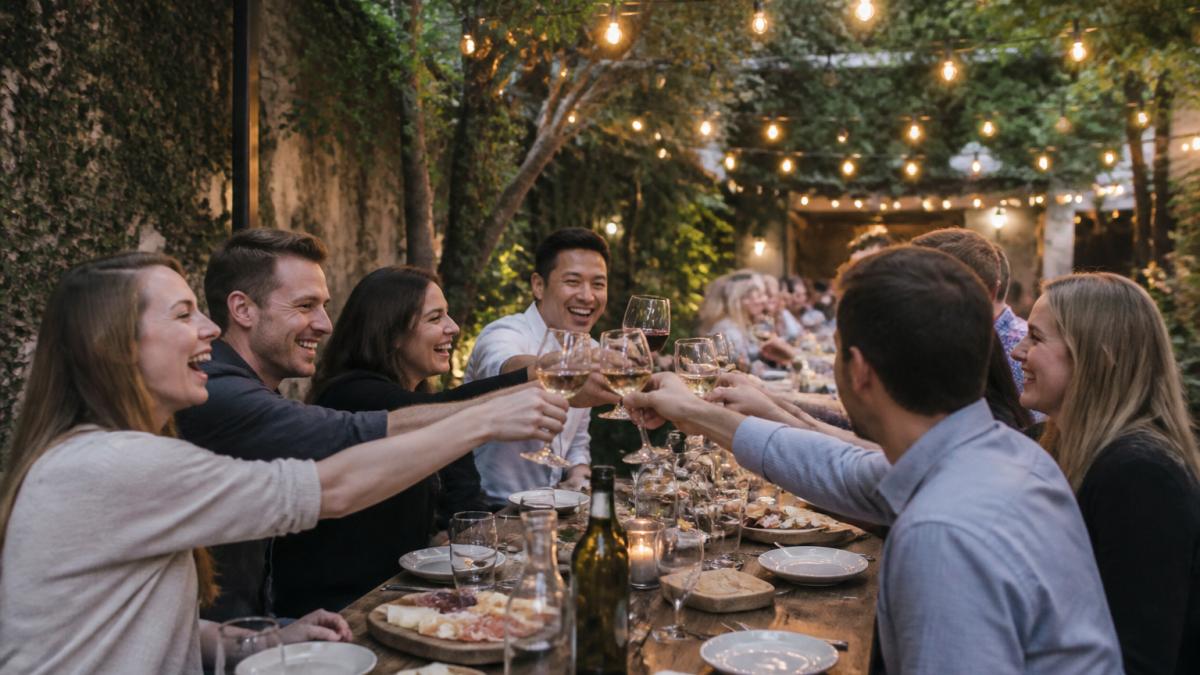
Vino Locale is a European-style wine garden and kitchen in downtown Palo Alto, established in 2005, that hosts private events for up to 100 guests. The garden and patio seating give groups room to spread out without shouting over each other.
Capacity, Atmosphere, and What Makes It Different
The space handles everything from a 12-person team lunch to a 100-guest celebration. Customizable wine flights and beer flights give groups something to share, and the tapas menu makes ordering for a crowd simple.
The garden setting is the differentiator. Groups that book outdoor space report far less of the “stuck in a meeting room” feeling that kills team-building energy.
How to Host Corporate Team Building Events at a Wine Garden
The best team building events at a wine garden pair a shared activity with flexible seating and a menu built for grazing. Structure matters more than gimmicks.
Here’s a simple framework we’ve seen work:
- Set a clear headcount window and confirm it with the venue at least two weeks out.
- Book the garden or patio rather than an indoor room when weather allows.
- Choose shared plates so people mix instead of staying in cliques.
- Add a wine or beer flight as an icebreaker activity.
- Reserve a quiet corner if anyone needs to take a call.
- Confirm delivery or pickup timing if you’re ordering in for a hybrid setup.
For a deeper look at structuring these gatherings, Harvard Business Review’s research on team building covers why shared experiences outperform formal exercises.
Ask about wifi and a quieter corner before you book. A venue that can absorb a mid-event conference call is worth more than one with a bigger patio.
Private Dining Rooms for Corporate Events: What to Expect
Private dining rooms for corporate events typically seat 10 to 40 people and come with a food-and-beverage minimum, a set or prix-fixe menu, and a fixed time window (often a two- to three-hour block). They suit executive dinners and client meetings where privacy and a controlled agenda matter more than mingling.
The Real Trade-Offs
- Pros: Quiet enough for toasts and table talk, a dedicated server, predictable pacing, and a door you can close.
- Cons: Minimum-spend thresholds that punish small headcounts, less flexibility on arrival and departure times, and a formality that can feel stiff for a casual team.
A common pattern: a 20-person group books a private room with a $2,500 food-and-beverage minimum, spends $125 per head before tax and a service charge, and ends up paying more per person than a 60-person group at the same venue. That’s not a rip-off, it’s how minimums amortize. If your group is larger than 40 or you want a relaxed vibe, a garden venue usually delivers more per dollar.
A Planning Checklist for French- and European-Themed Venues
If you’re specifically chasing the La Boheme aesthetic, candlelight, shared plates, wine-forward menus, a garden or courtyard, the standard corporate-event checklist misses a few things. Bring this list to your site visit:
Menu and beverage
- Confirm whether the menu is prix-fixe, family-style, or passed tapas. Family-style and shared plates drive more conversation than plated courses.
- Ask about wine flights or a curated by-the-glass list. A flight is a built-in icebreaker; a full open bar is a budget risk.
- Check dietary coverage: vegetarian, gluten-free, and non-alcoholic options should be standard, not a special request.
- Confirm whether the minimum is met by food only or food plus beverage.
Space and atmosphere
- Ask for a floor plan with table shapes marked. Round tables of 8-10 mix better than a single long table past 30 guests.
- Verify lighting: candlelight and string lights are the ambiance, but confirm there’s enough light for printed menus and name cards.
- Check noise: a courtyard absorbs sound; a low-ceilinged back room does not. Visit at the same time of day as your event if you can.
- Confirm whether the space is fully private or semi-private. Semi-private means you’ll hear the main dining room.
Logistics
- Ask about a weather backup if any part of the event is outdoors, a covered area or an indoor room of comparable size.
- Confirm A/V: a small PA for toasts, a screen if you’re presenting, and reliable Wi-Fi for anyone taking a call.
- Get the cancellation and headcount-change policy in writing. Group events almost always shift by a few people in the final week.
- Ask who your day-of contact is and whether they’ll be on site.
U.S. Small Business Administration’s guide to business events notes that matching the setting to the goal is one of the biggest factors in whether an event lands, and for a French- or European-themed gathering, the room itself is part of the program, not just the backdrop.
Ask the venue for photos from a recent group event, not the styled marketing shots. Real event photos show you the actual table layout, lighting, and how full the room looks at your headcount.
What to Ignore When Booking Group Event Venues
Most booking advice obsesses over the wrong details. Skip the flashy photos and focus on the five things that actually affect your event.
- Ignore “maximum capacity” without a floor plan. A room that “holds 100” may only seat 60 comfortably.
- Ignore reviews that don’t mention groups. A great date-night spot isn’t automatically a great group venue.
- Ignore per-person pricing without checking what’s included. Service fees and minimums change the math fast.
- Ignore ambiance claims you can’t verify. Visit in person or ask for recent event photos.
- Ignore rigid cancellation policies. Weather and headcount changes are normal for group events.
Booking a venue without confirming the rain plan is the most common mistake we see. An outdoor event with no backup can turn a team offsite into a scramble.
Conclusion: Finding the Right Fit for Your Group
Matching the venue to your group’s size, mood, and logistics is the whole game. Get those three right and the rest tends to fall into place.
At Vino Locale, we host groups of up to 100 in our European-style wine garden and kitchen, with customizable wine flights, tapas built for sharing, and a relaxed setting that works for both team building and casual celebrations. We’ve been doing this since 2005.
Get started with Vino Locale and book a garden space that fits your group.
Frequently Asked Questions
What are the best venues for corporate team building in the area?
The best group event venues for corporate team building offer flexible spaces, reliable wifi, and a relaxed atmosphere that encourages conversation. Look for venues that accommodate your guest count without feeling cramped, provide catering options, and have outdoor or semi-private areas. A European-style wine garden with customizable wine flights and tapas works well for teams that want a low-stress environment. Confirm capacity limits, reservation policies, and whether the venue can handle groups up to 100 before booking.
How do I choose a restaurant for a group of 50 or more people?
Start by confirming the venue can seat your guest count comfortably. Ask about private dining rooms for corporate events, group booking policies, and whether the menu scales for larger parties. Check accessibility, parking, and proximity to your office. For groups of 50 or more, request a walkthrough to assess the event space and ambiance. Also clarify catering options, deposit requirements, and cancellation terms. A venue that regularly hosts corporate events will have a streamlined reservation and event coordination process.
What amenities should I look for in a private event space?
Prioritize reliable wifi, adequate seating, climate control, and accessible restrooms. For corporate events, confirm AV capabilities, privacy options, and whether the venue provides event coordination support. Outdoor garden or patio seating adds flexibility for casual gatherings. Check if the venue offers customizable menus, wine flights, or catering that fits your event budget. Also ask about setup and breakdown times, noise levels, and whether the space is exclusively yours during the reservation window.
How far in advance should I book a venue for a group event?
For corporate events and holiday parties, book at least four to six weeks in advance. Popular dates in November and December fill quickly, so aim for two to three months out if you are planning a holiday party. Smaller gatherings of 20 to 30 guests may only need two to three weeks. Always confirm the venue’s cancellation policy and deposit schedule. If your group exceeds 50 people, start earlier to secure the event space and coordinate catering, seating, and any AV needs.